Back to smartelemfg Home
Contact us Merchants settle in
Back to smartelemfg Home
Home -Technical

What is Parallel Operation

Source: Maxwell He 2025-08-15 16:21:29

          Parallel operation​ involves connecting two or more independent AC power sources (e.g., generators, grids) to share electrical loads seamlessly. This process—synchronization—demands precise matching of voltage magnitude, frequency, and phase angles between systems before interconnection. Critical for grid expansion, backup power, and renewable integration, it enables redundant supply during failures. Failure to synchronize correctly risks catastrophic equipment damage due to out-of-phase currents. Modern systems use auto-synchronizers for real-time adjustments, allowing generators to support grids without interruption. ​Parallel operation​ underpins reliable large-scale power networks but requires rigorous protocols like IEEE 1547 compliance.

1. Parallel operation :Definition & Fundamentals​

​Parallel operation​ synchronizes independent AC systems (generators/grids) to operate as a unified network. Core requirements include:

  • Voltage difference ​​< ±5%​​
  • Frequency difference ​​< ±0.2 Hz​
  • Phase angle alignment ​​< ±10°.

​2. ​Parallel operation:Synchronization Process​

  • ​Pre-Synchronization Checks:
    • Measure voltage/frequency/phase mismatch.
    • Adjust generator governor (frequency) and exciter (voltage).
  • ​Closure Moment:
    • Auto-synchronizer triggers breaker closure when parameters align (near-zero circulating currents).

​3. ​Parallel operation:Key Applications​

  • ​Generator Grid Connection: Integrating new power sources.
  • ​Grid Interconnection: Linking regional networks (e.g., cross-border power exchange).
  • ​Microgrids: Seamless transition between islanded/grid-tied modes.

​4. ​Parallel operation:Risks & Safety Protocols​

  • ​High-Risk Scenarios:
    • Destructive torque from phase imbalance.
    • Relay malfunctions due to sudden current surges.
  • ​Mitigation Measures:

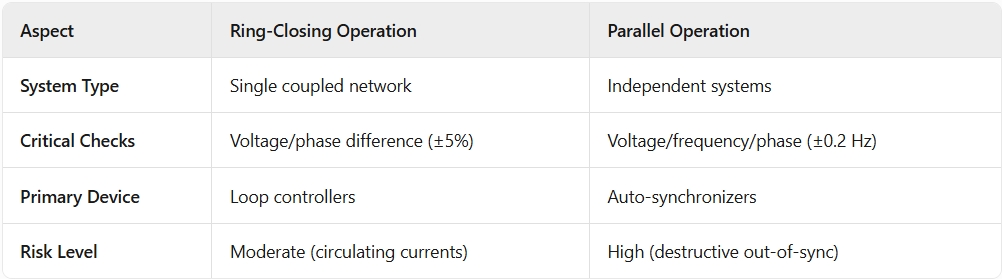
​5. Comparison: Ring-Closing vs. Parallel Operation
6.​Parallel operation: Industry Standards​

  • ​IEC 60255-121: Protection relays for synchronization.
  • IEEE 1547: Grid interconnection requirements.
  • ​NERC PRC-024: Frequency response compliance.

​7. Case Study: Grid Resilience​

       During California’s 2020 blackouts, ​parallel operation​ enabled rapid back-feeding from Nevada’s grid via
Product recommendations More
GWZC-9581 Low-voltage generator protection relay
detail
GWZC-9506 Cable insulation monitoring device (IMD)​​(ANSI 64)
detail
GOWE-9000 Partial discharge online monitoring system
detail
GOWE-9000 Wireless Temperature Monitoring System for Substations
detail
GWZC-9505 Feeder Arc Flash Protection Relay
detail
Technical More
Transformer Protection Relay Panel
Renovation Scheme for Unattended Automatic System of Hydropower Station
The core of the transformation of the unattended automation system for hydropower stations is to upgrade the traditional manually attended power station into a modern intelligent power station with "unattended operation and minimal personnel on duty" through computerized monitoring, intelligent sensing, reliable communication and remote centralized control. It realizes remote monitoring, automatic control, fault self-diagnosis and safety early warning, greatly reducing labor costs and improving operational efficiency and safety. Among them, the secondary electrical system, as the "nervous system, brain and safety line of defense" of the power station, is the core support for the unattended transformation. Without a reliable secondary system, true unattended operation cannot be achieved. Therefore, this integration will focus on improving the detailed content of secondary electrical equipment while retaining the full process details of the transformation.
2026/04/21
Ground Distance Protection (21G)
Differences Between Phase-to-Phase Distance Protection (21P) and Ground Distance Protection (21G)
The core difference between phase-to-phase distance protection and ground distance protection lies in the selection of measured quantities, fault response range, and connection methods. They complement each other to form a complete distance protection system for high-voltage transmission lines, both following the basic principle: operation if the measured impedance is less than the setting impedance.
2026/03/04
Generator Protection Panel
Generator Protection Relay Panel : Composition and Function
Integrating protection, measurement, and communication, the Generator Protection Relay Panel can realize the protection and control of various units, enabling unattended or minimally attended operation. It can achieve generator differential protection, rotor earth fault protection, stator earth fault protection, excitation protection, overcurrent protection, overvoltage protection, overload protection, backup protection, etc.
2025/11/25
Transformer Protection Relay Panel
Transformer Protection Relay Panel:Composition and Function
Transformer Protection Relay Panel is primarily used in automation systems for substations and distribution stations in power systems of 11kV, 33kV, 132kV and above. Its main function is to ensure that the transformer can promptly trip the faulty circuit in case of overload, short circuit, gas relay activation, and other abnormal operating conditions, thereby protecting the main transformer from damage and preventing the expansion of faults.
2025/11/24
Inquiry Consultation
+86-17621210051
+86-17621210051
+86-17621210051
+86-17621210051
home product email
live chat
my